
Mindset is a reflection of our assumptions, biases, way of thinking, and beliefs that is visible in our choices, decisions and behavior.
An Agile mindset characterizes flexibility and willingness to adapt to changes and unforeseen circumstances.
A person / team having an Agile mindset is:
so that when needs / circumstances change, they are ready to adapt to it.
An Agile Mindset underpins the work of successful agile teams.
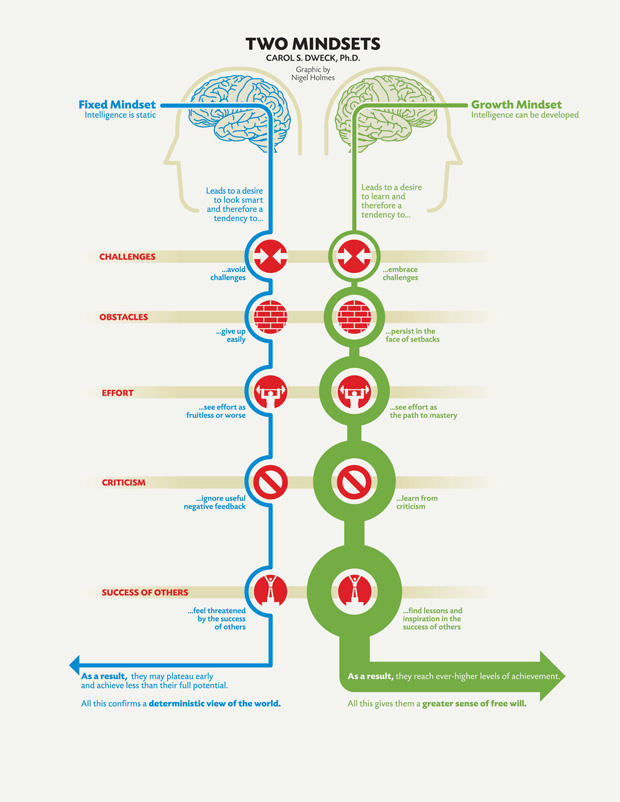
On the other hand, someone having a Fixed Mindset would be relatively less flexible, thinks that they know it all, assumes there will be no changes, is not open to learning / feedback, avoid trying new ideas etc.
‘Mindset’ by Carol Dweck introduced a comparision between a Growth Mindset and a Fixed Mindset and how one can inculcate a Growth Mindset.
The Manifesto for Agile Software Development Established in 2001, also referred as Agile Manifesto comprises of four Values and twelve Principles that 17 manifesto authors agreed on to be essential to be adaptable for a team or an organization.
We are uncovering better ways of developing software by doing it and helping others do it. Through this work we have come to value:
Individuals and interactions over processes and tools Working software over comprehensive documentation
Customer collaboration over contract negotiation Responding to change over following a plan
That is, while there is value in the items on the right, we value the items on the left more.
Principles behind the Agile Manifesto
We follow these principles:
Our highest priority is to satisfy the customer through early and continuous delivery of valuable software.
Welcome changing requirements, even late in development. Agile processes harness change for the customer’s competitive advantage.
Deliver working software frequently, from a couple of weeks to a couple of months, with a preference to the shorter timescale.
Business people and developers must work together daily throughout the project.
Build projects around motivated individuals. Give them the environment and support they need, and trust them to get the job done.
The most efficient and effective method of conveying information to and within a development team is face-to-face conversation.
Working software is the primary measure of progress.
Agile processes promote sustainable development. The sponsors, developers, and users should be able to maintain a constant pace indefinitely.
Continuous attention to technical excellence and good design enhances agility.
Simplicity–the art of maximizing the amount of work not done–is essential.
The best architectures, requirements, and designs emerge from self-organizing teams.
At regular intervals, the team reflects on how to become more effective, then tunes and adjusts its behavior accordingly.
Manifesto Authors: Kent Beck, Mike Beedle, Arie van Bennekum, Alistair Cockburn, Ward Cunningham, Martin Fowler, James Grenning, Jim Highsmith, Andrew Hunt, Ron Jeffries, Jon Kern, Brian Marick, Robert C. Martin, Steve Mellor, Ken Schwaber, Jeff Sutherland, Dave Thomas
Empiricism asserts that knowledge comes from experience and making decisions based on what is observed (Most recent, Factual, Information).
Scrum is founded on the three pillars of Empiricism: Transparency, Inspection and Adaptation.
Transparency: Scrum artifacts create transparency of needed information. Transparency enables Inspection. Inspection without transparency is misleading and wasteful.
Inspection: Four formal Scrum events enable opportunities for inspection and adaptation. Inspection of the information enables to know if the actual resutls match or deviate from the desired results.
Adaptation: Four formal Scrum events enable opportunities for inspection and adaptation. If during the inspection, the actual resutls is found to deviate from the desired results, we can adapt the input, so the desired results can be achieved.
Benefits: Empirical evidence, grounded in factual data from observations and what has already happened, guides teams towards objective and informed decision-making. It minimizes the impact of personal biases and opinions, enhancing the Transparency, Speed and Effectiveness of the decision making process.
Examples: Decisions where empiricism can be used:
a) How many Product Backlog Items should the team pick in the next sprint?
b) How much buffer capacity to reserve for unplanned work such as Ad-hoc requests, Production Issues, etc.?
The Scrum Master is responsible for promoting and supporting Scrum. Scrum Masters do this by helping everyone understand Scrum theory, practices, rules, and values.
Scrum Master is not a new name for the traditional (Project) Manager. Rather, the Scrum Master is a true leader who leads through serving.
The Scrum Master Educates, Coaches, Mentors and Facilitates to higher performance and agility.
The Scrum Master serves the Developers, the Product Owner and the Organization.
Also see: Scrum Master as a Coach, Scrum Master as a Leader
Scrum Values offer overarching guiding-rails to how team members behave, act, work, and collaborate as a team.
Scrum offers five Scrum Values: Focus, Openness, Respect, Commitment and Courage.
When a Scrum Team and the people they work with embody these Scrum Values, they a build high trust environment.
Lean thinking is an organizational approach, based on the view that non-value-added activities (waste) in products and services impedes customer value creation. It focuses on ways to organize human activities to effectively deliver value while reducing muda (waste), mura (unevenness) and muri (overburden).
Lean Thinking ideas emerged from studying Toyota Production System (TPS). It was found that if every employee is trained to identify wasted effort, steps and time in their own work and to work together as a team to improve processes by eliminating such waste, the resulting culture (basic thinking, mindset & assumptions) will deliver more value effectively while improving team work, their capability, and motivation.
Also see: Lean Waste, Lean Product Development, Kaizen, PDCA
The Product Backlog is one of the Scrum Artifacts.
The Product Backlog is an ordered list of everything that is known to be needed in the product. It is the single source of requirements for any changes to be made to the product.
The Product Backlog is an emergent artifact and is never complete. It is constantly changing to reflect the ever-changing needs of the stakeholders.
The Product Backlog is owned by the Product Owner.
The Product Backlog is ordered by value, with the most valuable items at the top of the list. The Product Owner is responsible for ordering the Product Backlog, but may do so with input from the Development Team and other stakeholders.
Key benefits of a Product Backlog include:
The Sprint Backlog is one of the Scrum artifacts that creates transparency of the work of the current Sprint.
It is set of Product Backlog Items selected by the Developers for the Sprint, plus a plan for delivering the product Increment and realizing the Sprint Goal.
The increment is the sum of all the Product Backlog items completed during a Sprint and the increments from previous Sprint.
Increment creates transparency of the value created to date.
Example: If a Scrum team is writing a book, a chapter of the book could be an increment. Another example could be iPhone 14 as an increment.
Also see: Incremental Development
A burn down chart is a graphical representation of the work left to do versus the time.
If a burn down chart is created at for a two week Sprint having 8 Product Backlog Items (work) in the Sprint Backlog, the X-Axis will have 0 – 10 days and the Y-Axis will show 0 – 8 PBIs.
As the days pass and the work remaining reduces, the graph from the top left will gradually trend (burn) down towards bottom right.
The developers may (choose to) create and update the Sprint burn-down chart to graphically track the progress during the sprint.
The Scrum Master should neither create, nor update the Burn-Down chart, to ensure that the Developers retain the ownership of tracking and monitoring the progress of their Sprint work.
Also see: Burn Up Chart, Cumulative Flow Diagram (CFD)